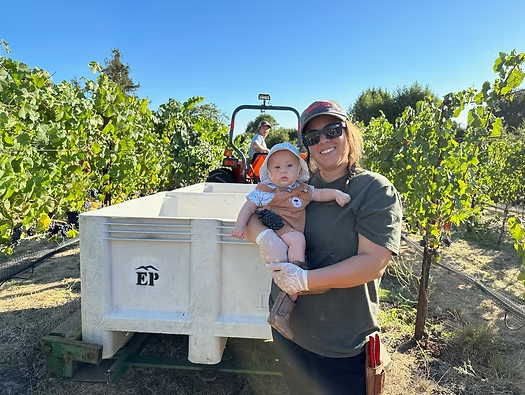
It’s late August 2026, and we’ve picked all of our Pinot Noir from our estate vineyard in the south end of the Napa Valley. Read that again: August. All of the Pinot Noir is in. That’s a crazy fact. We usually don’t start picking Pinot Noir until September. This year, we were finished before the month was out; it was the earliest harvest in our 43-year history. And that’s not all…. our eight-acre Pinot Noir vineyard yielded just 5.4 tons of Pinot this year too – it was the lightest crop we’ve ever seen. The berries were tiny. Some we’re so small they were seedless. So, 2026 will go down as the earliest and lightest crop in our vineyard’s 43-year history.
We harvested the Pinot Noir in two passes, bringing in the first 2.8 tons on August 6th and the remaining 2.6 tons on August 20th. Splitting the vineyard into two picks is unusual for us. Most years, our small vineyard ripens at the same pace, allowing us to harvest everything together.
We grow 3 distinct clones, or types, of Pinot Noir within these eight acres. Among them are the Pommard clone, which originated in Burgundy, and two California heritage selections known as “Swan” and “R.” Each behaves a little differently in the vineyard, but typically they reach maturity within a close enough window to be picked together.
The last time the vineyard divided itself like this was in 2020, but that was due to some unusual triple digit heat waves that arrived along with humidity and lightening, and eventually lead to one of the largest wildfires in California’s history. A story for another day….
When the vineyard gives us an unusual year, we are often inspired to try something unusual in the cellar. We are working with a new consulting winemaker this year named Clayton Kirchhoff, who had a few ideas for us too. So, in the spirit of embracing new beginnings, it felt like the right opportunity to experiment.
Normally, all of our Pinot Noir passes through a destemmer, which separates the berries from their stems before fermentation. In an experimental ferment this year, we left 30% of the fruit intact (berries, stems, and all) and destemmed the remaining 70% as usual. Using whole clusters during fermentation can contribute another layer of tannin, texture, spice, and aromatic complexity to Pinot Noir.
Both of the Pinot Noir fermentations finished beautifully. The chemistry was nearly textbook-perfect, and the young wines are already showing plenty of personality. Clayton described the first lot, the Pommard and Swan blend, as “zippy.” It’s bright, fruit-forward, energetic, and carried by lively acidity. We like what we are tasting!
As we write this, the Cabernet Sauvignon and Cabernet Franc are still on the vine, enjoying the mild temperatures the 2026 summer has delivered to the Napa Valley. More harvest updates to come…